
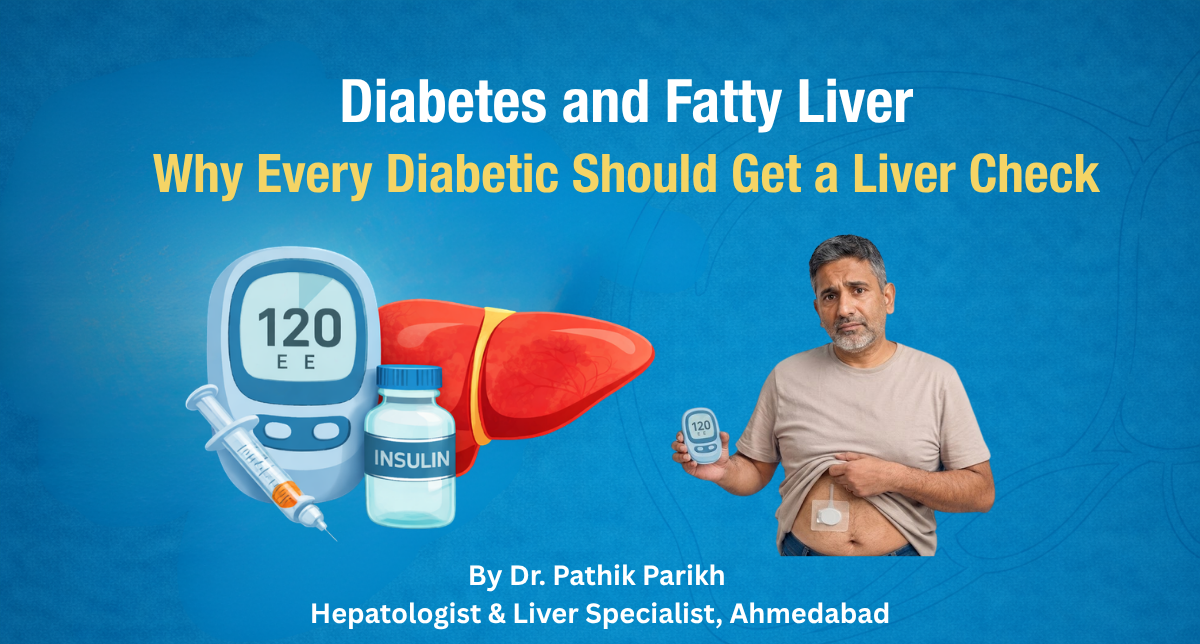
Diabetes and Fatty Liver: Why Every Diabetic Should Get a Liver Check
By Dr. Pathik Parikh | Hepatologist & Liver Specialist, Ahmedabad
India has over 100 million people living with Type 2 diabetes — the highest number of any country in the world. Yet very few of these patients know that diabetes and fatty liver disease are deeply, biologically intertwined conditions that worsen each other in a silent, self-reinforcing cycle.
If you have Type 2 diabetes, the chances that you also have fatty liver are strikingly high — and most patients never find out until significant damage has already been done. This article explains the connection, the risks and most importantly, what you can do about it.
The Scale of the Problem in India
| 70% of Diabetics | Up to 70% of patients with Type 2 diabetes have Non-Alcoholic Fatty Liver Disease (NAFLD) — most without any symptoms. |
| 2–4x Higher Risk | Diabetics are 2 to 4 times more likely to develop cirrhosis and liver cancer compared to non-diabetics with fatty liver. |
| 1 in 5 Will Progress |
Approximately 20% of people with fatty liver will develop significant fibrosis or cirrhosis over their lifetime — and diabetes dramatically accelerates this progression |
| 100M+ Indians at Risk | India’s 100+ million diabetics represent the world’s largest population at risk of undiagnosed liver disease. |
Why Are Diabetes and Fatty Liver So Closely Linked?
The connection between diabetes and fatty liver is not coincidental — it is biological. Both conditions share a single root cause: insulin resistance.
What Is Insulin Resistance?
Insulin is a hormone produced by the pancreas that acts like a key — it unlocks cells to let glucose (blood sugar) in for energy. In insulin resistance, the cells stop responding to this key properly. Blood sugar stays high, the pancreas pumps out more insulin to compensate and the body begins storing excess energy as fat — particularly in the liver.
The Vicious Cycle
Diabetes and fatty liver do not just coexist — they actively make each other worse:
| Insulin Resistance | Cells stop responding to insulin properly — blood sugar stays elevated |
| ▼ | |
| Excess Fat Directed to Liver | The liver compensates by absorbing and storing excess fat from the bloodstream |
| ▼ | |
| Fatty Liver Worsens Insulin Resistance | Fat-laden liver cells produce inflammatory signals that further impair insulin response |
| ▼ | |
| Blood Sugar Rises Further | Worsening insulin resistance leads to higher blood sugar, more fat and the cycle continues |
This bidirectional relationship means that treating one condition in isolation — managing blood sugar but ignoring the liver, or treating fatty liver without addressing diabetes — is always incomplete.
How Diabetes Damages the Liver Over Time
In most diabetic patients with fatty liver, the damage progresses through predictable stages:
| Stage | Condition | What Is Happening |
|---|---|---|
| Stage 1 | Simple Fatty Liver (Steatosis) | Fat accumulates in liver cells. Fully reversible. No symptoms. Most patients never know they have it. |
| Stage 2 | NASH (Non-Alcoholic Steatohepatitis) | Fat causes inflammation and liver cell damage. Elevated liver enzymes may appear. Still potentially reversible. |
| Stage 3 | Fibrosis (Scarring) | Repeated inflammation leads to scarring. Liver function begins to decline. Partially reversible with treatment. |
| Stage 4 | Cirrhosis | Widespread scarring replaces healthy liver tissue. Largely irreversible. Risk of liver failure and liver cancer rises sharply |
What makes this particularly dangerous for diabetics is speed. Studies show that diabetes can accelerate the progression from simple fatty liver to fibrosis and cirrhosis — a journey that might take 20–30 years in a non-diabetic can take just 8–12 years in a poorly controlled diabetic.
Who Is At Highest Risk
While all diabetics are at risk, certain factors significantly increase the likelihood of advanced liver disease:
- Long-standing diabetes (more than 10 years duration)
- Poor blood sugar control (HbA1c consistently above 8%)
- Obesity, especially central/abdominal obesity
- High triglycerides or low HDL cholesterol
- High blood pressure (hypertension)
- Alcohol consumption — even moderate amounts are more harmful with fatty liver
- Sleep apnoea — a commonly overlooked condition that worsens both diabetes and liver fat
- Hypothyroidism (low thyroid) — independently increases liver fat accumulation
- Polycystic Ovarian Syndrome (PCOS) — strongly linked to both insulin resistance and fatty liver in women
The Metabolic Syndrome Link
-
- If you have three or more of the following, you have Metabolic Syndrome — and your risk of significant liver disease is very high:
- Abdominal obesity (waist > 90 cm in men, > 80 cm in women for Indians)
- High fasting blood sugar (> 100 mg/dL) or diagnosed diabetes
- High triglycerides (> 150 mg/dL)
- Low HDL cholesterol (< 40 mg/dL in men, < 50 mg/dL in women)
- High blood pressure (> 130/85 mmHg)
The Liver Cancer Risk That Most Diabetics Don’t Know About
One of the most under-recognised consequences of the diabetes–liver connection is the increased risk of hepatocellular carcinoma (HCC) — primary liver cancer.
Research consistently shows that diabetics with fatty liver are 2–3 times more likely to develop liver cancer than the general population. In India, where Hepatitis B is also prevalent, the risk is even higher when both conditions are present.
The critical point: liver cancer arising from NAFLD and diabetes often develops without prior symptoms. Routine monitoring — a 6-monthly liver ultrasound and AFP blood test — in high-risk diabetics with advanced fatty liver or cirrhosis is the only reliable way to detect it early, when it is still treatable.
How to Check If Your Liver Is Affected
The good news: assessing your liver health is quick, painless, and affordable. Here is what to ask your doctor for:
Step 1: Blood Tests
- Liver function tests (LFT) — includes SGPT (ALT), SGOT (AST), bilirubin, albumin
- Fasting lipid profile — cholesterol and triglycerides
- HbA1c — 3-month average blood sugar
- CBC, TSH and Vitamin D — often abnormal alongside fatty liver
Important: Normal liver enzymes do NOT rule out fatty liver. Many patients with significant fatty liver have completely normal SGPT/SGOT levels.
Step 2: Liver Ultrasound
A simple abdominal ultrasound can detect fatty liver and liver enlargement. It is non-invasive, widely available, and should be done annually in diabetic patients.
Step 3: Fibroscan
A Fibroscan is the gold standard for assessing the degree of fatty liver (CAP score) and fibrosis (kPa score) non-invasively. Every diabetic with known fatty liver — or with elevated liver enzymes — should have a Fibroscan done. It takes 10 minutes and provides results immediately.
Recommended Screening Schedule for Diabetics
-
- Liver function tests: Every 6–12 months
- Abdominal ultrasound: Every 12 months
- Fibroscan: At baseline, then every 1–2 years depending on severity
- Liver cancer screening (ultrasound + AFP): Every 6 months if F3–F4 fibrosis is confirmed
- See a hepatologist: If any test is abnormal, or if fatty liver has been present for more than 2 years
What You Can Do: Managing Both Conditions Together
The most powerful insight from the diabetes–fatty liver connection is this: the same lifestyle changes that improve diabetes also directly improve fatty liver — and vice versa. You are not fighting two separate battles. You are fighting one.
| Action | Benefits For Diabetes | Benefit For Liver |
|---|---|---|
| Reduce refined carbs & sugar | Lowers blood sugar spikes | Reduces fat deposited in liver |
| Daily 30-min brisk walk | Improves insulin sensitivity | Burns liver fat directly |
| Lose 5–10% body weight | Reduces HbA1c significantly | Can reverse Grade 1–2 fatty liver |
| Add fibre (dal, vegetables) | Slows glucose absorption | Feeds gut bacteria that protect liver |
| Limit alcohol completely | Prevents sugar overload | Prevents accelerated liver damage |
| Treat sleep apnoea | Improves insulin response | Reduces liver inflammation |
| Regular liver monitoring | Catch complications early | Enables timely treatment |
A Note on Diabetes Medications and the Liver
Some diabetes medications can actually benefit the liver. Medications such as GLP-1 receptor agonists (like semaglutide/liraglutide) and SGLT2 inhibitors (like empagliflozin/dapagliflozin) have shown significant benefit in reducing liver fat and inflammation in clinical trials.
On the other hand, certain older medications and herbal remedies can stress the liver. Always inform both your diabetologist and your hepatologist about every medication and supplement you are taking — including Ayurvedic preparations.
Frequently Asked Questions
I have controlled diabetes. Do I still need to worry about my liver?
Yes. Even well-controlled diabetes is associated with fatty liver. Blood sugar control reduces the rate of progression, but it does not eliminate the risk. The liver needs to be monitored independently.
My diabetes doctor has never mentioned my liver. What should I do?
Ask your diabetologist specifically for a liver function test and ultrasound. Better still, book a consultation with a hepatologist for a dedicated liver assessment. Many diabetic patients receive excellent sugar management but no liver monitoring — this is a gap that needs to be filled.
Can losing weight cure both my diabetes and fatty liver?
Significant weight loss — even 7–10% of body weight — can lead to remission of Type 2 diabetes in some patients and reversal of Grade 1–2 fatty liver in many. It is not a guaranteed cure, but it is the single most effective intervention available.
My Fibroscan showed F2 fibrosis. Can this be reversed if I control my diabetes well?
F2 fibrosis is potentially reversible with good metabolic control, weight loss and treatment of the underlying cause. This is exactly why early detection matters — at F2, you still have a real opportunity to turn things around.
Should I see a diabetologist or a hepatologist?
Ideally, both. Your diabetologist manages blood sugar; your hepatologist manages the liver. These are complementary, not competing. Ask your diabetologist for a hepatology referral if you have fatty liver or contact a hepatologist directly for a liver-focused consultation.
Are You a Diabetic Who Has Never Checked Their Liver?
If you have Type 2 diabetes — even well-controlled diabetes — your liver may be silently accumulating fat. A single Fibroscan appointment can tell you exactly where your liver stands. Early detection means more options, easier reversal and better long-term health for both your liver and your blood sugar.
Dr. Pathik Parikh — Hepatologist & Liver Specialist, Ahmedabad
📞 Book an Appointment: Click here
Medical Disclaimer: This article is for educational and informational purposes only and does not constitute medical advice. Statistics cited are based on published medical literature and may vary by population and study design. Please consult Dr. Pathik Parikh or a qualified healthcare provider for personalised medical guidance.