
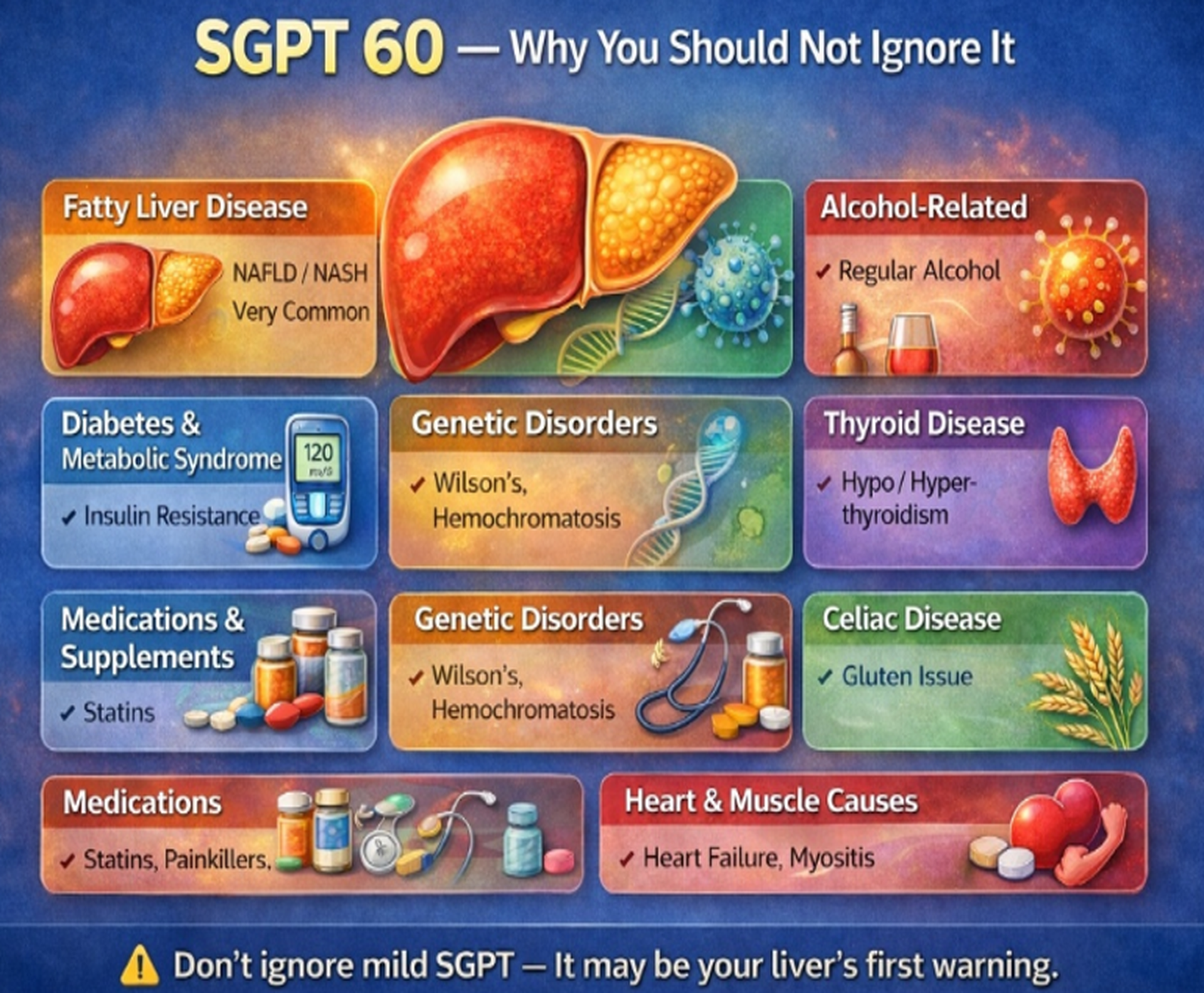
SGPT 60 —Why You Should Not Ignore It
Your lab report says SGPT 60. The lab’s reference range goes up to 40. Your doctor’s clinic is closed for the weekend. You tell yourself: it’s only slightly high, it’s probably nothing. This article is about why that assumption can be dangerous — and what you should do instead.
By Dr. Pathik Parikh | Hepatologist & Liver Specialist, Ahmedabad
What Exactly Is SGPT?
SGPT stands for Serum Glutamic-Pyruvic Transaminase. Its modern name is ALT — Alanine Aminotransferase. Both names refer to the same enzyme and you will see either one on a blood test report depending on which laboratory you use.
ALT/SGPT is produced primarily inside liver cells. When liver cells are healthy and intact, this enzyme stays where it belongs — inside the cell. But when liver cells are stressed, injured, or dying, the cell membrane breaks down and SGPT leaks into the bloodstream. That is why a blood test can detect it.
In simple terms: SGPT is your liver’s distress signal. A raised level means liver cells are being damaged — right now, or in an ongoing process. The higher the value, the more vigorous the damage. But even a mildly elevated value, like 60, is telling you something is wrong.
Normal Reference Range
Most laboratories define the normal upper limit of SGPT as 40 U/L for men and 35 U/L for women, though some labs use slightly different cutoffs. A value of 60 U/L therefore represents a 50–70% elevation above the upper limit of normal — enough to be clinically meaningful and enough to warrant investigation.
“It’s Only a Little High” — The Dangerous Comfort Zone
There is a natural human tendency to minimise mildly abnormal results. We read them, note they are above normal and then reassure ourselves that since it is not dramatically elevated, it must not be serious. With SGPT, this reasoning is particularly flawed for two reasons.
Reason 1: The Disease, Not the Number, Determines Severity
A person with early hepatitis C infection might have an SGPT of 55. A person with autoimmune hepatitis — a condition that, if untreated, can rapidly destroy the liver — might present with an SGPT of 65. A person with early non-alcoholic steatoh epatitis (NASH), which can silently progress to cirrhosis over a decade, may show an SGPT of 60 for years. The modest elevation is not a sign that the underlying condition is modest — it is simply the early signature of a disease that has not yet declared itself fully.
Reason 2: The Liver Has Enormous Reserve Capacity
The liver can lose up to 70–80% of its functional capacity before you feel any symptoms. This is both its great strength and its great weakness. It means that by the time symptoms appear — jaundice, swelling, confusion, bleeding — the liver is already in serious trouble. An elevated SGPT at 60, when you feel completely well, is often the only early warning you will get. Dismissing it means missing the window when intervention is simplest and most effective.
Of liver function can be silently lost before any symptoms appear. SGPT 60 may be your only early warning.
One Number, Many Diseases: What Could SGPT 60 Mean?
This is the part that most patients find surprising. A mildly elevated SGPT is not a diagnosis — it is a clue. The same number can arise from an enormous range of conditions spanning multiple organ systems. Here is what a thorough doctor considers when they see SGPT 60 on your report
| Category | Condition / What the doctor looks for |
|---|---|
| Fatty Liver Disease | Non-Alcoholic Fatty Liver Disease (NAFLD/MASLD) and Non-Alcoholic Steatohepatitis (NASH) — the most common cause of mildly elevated SGPT in urban India today. Often silent, often missed. |
| Viral Hepatitis | Hepatitis B (chronic carrier state), Hepatitis C (often asymptomatic for years), Hepatitis A and E (acute infection). All can present with SGPT in the 50–80 range. |
| Alcohol-Related | Even moderate regular alcohol consumption can sustain SGPT at mildly elevated levels. Alcohol-related fatty liver and early alcoholic hepatitis must be considered. |
| Thyroid Disease | Both hypothyroidism and hyperthyroidism are underrecognised causes of mild liver enzyme elevation. A simple TSH test can rule this in or out. |
| Diabetes & Metabolic Syndrome | Insulin resistance — even before formal diabetes is diagnosed — frequently elevates SGPT through fatty infiltration of the liver. |
| Autoimmune Hepatitis | A serious condition in which the immune system attacks liver cells. It can begin silently with modest enzyme elevation before becoming aggressive. |
| Medications & Supplements | Paracetamol (even at ‘safe’ doses if taken regularly), statins, anti-tuberculosis drugs, anti-epileptics, NSAIDs and many Ayurvedic or herbal preparations can all elevate SGPT. |
| Wilson’s Disease | A genetic condition causing copper accumulation in the liver. Often diagnosed in young adults or children. Missed if not specifically looked for. |
| Haemochromatosis | A genetic iron overload disorder that silently damages the liver, heart and pancreas over decades. SGPT may be mildly elevated for years. |
| Celiac Disease | Gluten intolerance is a surprisingly common but rarely tested cause of mild liver enzyme elevation in India. |
| Muscle Disease | Vigorous exercise, muscle injuries, myositis and certain muscular dystrophies release ALT from muscle tissue — not the liver — causing elevation. |
| Heart & Vascular | Heart failure (congestive hepatopathy) and Budd-Chiari syndrome (hepatic vein obstruction) can raise SGPT via passive liver congestion. |
This is not an exhaustive list. It is, however, sufficient to make the point: SGPT 60 is not a single disease. It is a signpost that requires context — your history, your lifestyle, your medications, your family history and crucially, your other blood tests — before a cause can be identified.
The Most Common Culprit: Fatty Liver Disease
If you are an adult in urban India, have a sedentary job, eat a diet rich in refined carbohydrates and processed foods and your SGPT is 60 — fatty liver disease is statistically the most likely explanation. And it is one that deserves particular attention.
Non-Alcoholic Fatty Liver Disease (NAFLD), now increasingly called Metabolic Dysfunction-Associated Steatotic Liver Disease (MASLD), refers to the accumulation of fat in liver cells in people who drink little or no alcohol. It affects an estimated 25–38% of adults in India and is closely linked to obesity, type 2 diabetes, high triglycerides and high blood pressure.
In its early stage, fatty liver is largely reversible with lifestyle changes. But in a significant proportion of patients, it progresses to NASH — Non-Alcoholic SteatoHepatitis — in which fat is accompanied by inflammation and cell death. NASH can quietly progress to cirrhosis (permanent scarring) and liver cancer without ever producing major symptoms until the damage is advanced.
⚠ The Silent Decade
Studies show that many patients with NASH-related cirrhosis cannot identify any specific symptoms looking back over the decade during which their disease progressed. Their only abnormal finding, sometimes for years, was a mildly elevated SGPT between 40 and 80. This is precisely why SGPT 60 deserves follow-up.
Viral Hepatitis: The Infection You May Not Know You Have
Hepatitis B
India has one of the world’s largest burdens of chronic Hepatitis B infection, with an estimated 40 million carriers. A significant proportion of these individuals are in what is called the ‘immune-tolerant’ or ‘inactive carrier’ phase — they feel entirely well, have no symptoms and their SGPT may be only mildly elevated, hovering between 40 and 80. Yet the virus is present and without appropriate monitoring and treatment, it can reactivate and cause severe liver damage, cirrhosis, or hepatocellular carcinoma (liver cancer).
A simple Hepatitis B surface antigen (HBsAg) test, costing less than Rs 300, can identify this infection. If you have not had this test done alongside your SGPT, it needs to happen.
Hepatitis C
Hepatitis C is called ‘the silent epidemic’ for good reason. Most people infected with the Hepatitis C virus have no symptoms for decades. Their SGPT may fluctuate mildly — sometimes normal, sometimes in the 50–80 range — while the virus slowly inflames and scars the liver over 20–30 years. The critical point today is that Hepatitis C is curable. Modern Direct-Acting Antiviral (DAA) therapy can eliminate the virus in 8–12 weeks with minimal side effects and over 95% cure rates. But you cannot cure a disease you have not diagnosed.
A Test That Could Save Your Life
If your SGPT is 60 and you have never been tested for Hepatitis B and C, ask your doctor for HBsAg and Anti-HCV antibody tests. Both are inexpensive, widely available and could reveal a curable or controllable infection before it causes irreversible damage.
The Medicines and Supplements in Your Cabinet May Be the Problem
Drug-induced liver injury (DILI) is one of the most underdiagnosed causes of elevated liver enzymes. Patients rarely connect the supplement they have been taking for six months with the mildly abnormal SGPT they discovered at a routine check-up. But the link is often there.
Common Offenders Include:
- Paracetamol (Acetaminophen) — safe at the recommended dose, but frequently taken in excess, particularly when combined with cold-and-flu products that also contain it
- Statins (cholesterol-lowering drugs) — cause mild, usually harmless SGPT elevation in some patients, but must be differentiated from true liver injury
- Anti-tuberculosis drugs (Rifampicin, Isoniazid, Pyrazinamide) — classically cause liver enzyme elevation and must be monitored
- NSAIDs (Ibuprofen, Diclofenac) — especially with long-term use
- Herbal and Ayurvedic preparations — multiple heavy-metal contaminated or hepatotoxic herbal products have been documented to cause liver damage
- Protein supplements and bodybuilding products — often contain undisclosed additives
- Anti-epileptic drugs (Phenytoin, Valproate, Carbamazepine) — well-known hepatotoxins with dose-dependent effects
Always bring a complete list of every medication, over-the-counter drug, herbal supplement and protein powder you take to your doctor’s appointment. This list is not supplementary information — it is diagnostically essential.
The Thyroid-Liver Connection You Probably Did Not Know About
One of the most frequently missed causes of mildly elevated SGPT in clinical practice is thyroid dysfunction — both overactive (hyperthyroidism) and underactive (hypothyroidism) thyroid glands can raise liver enzymes.
Hypothyroidism slows the body’s metabolism and can reduce bile flow, leading to cholestatic liver injury. Hyperthyroidism, when severe, can cause direct hepatocellular damage through increased metabolic demand and oxygen consumption in liver tissue. Many patients with newly diagnosed thyroid disease discover their SGPT normalises once thyroid function is corrected — without any other intervention.
Similarly, insulin resistance — the metabolic state that precedes type 2 diabetes — promotes fat deposition in the liver (fatty liver) and chronic low-grade inflammation, both of which elevate SGPT. In many patients, SGPT 60 is the first abnormal laboratory finding, arriving years before a fasting glucose result crosses the diabetic threshold. In this sense, your mildly elevated SGPT may actually be an early warning of metabolic disease, not just liver disease.
SGPT as a Metabolic Barometer
Think of your SGPT not just as a liver test, but as a metabolic health indicator. Persistently elevated SGPT in the 50–80 range, in a patient who is overweight, has a large waist circumference and borderline blood sugar or triglycerides, is often the earliest abnormal signal that the metabolic syndrome is quietly setting in.
The Conditions That Are Easily Missed — and Easily Treated If Found Early
Wilson’s Disease
Wilson’s disease is a genetic condition in which copper cannot be properly excreted by the liver and accumulates in the liver, brain, kidneys, and eyes. It typically manifests in the second and third decades of life. Many young patients with Wilson’s disease present initially with mildly elevated liver enzymes — often an SGPT in the 50–100 range — before more obvious symptoms develop. It is entirely treatable with copper-chelating medications or zinc supplementation if caught early. If left undetected, it progresses to cirrhosis, psychiatric disturbance and neurological disease.
Hereditary Haemochromatosis
Haemochromatosis is a genetic iron overload disorder that causes iron to accumulate in the liver, heart, pancreas and joints over decades. It is more common than most physicians in India realise. Early in the disease, the only abnormality may be a mildly elevated SGPT and a raised serum ferritin. It is one of the most treatable genetic liver diseases — regular therapeutic phlebotomy (blood donation) can prevent all complications if begun before cirrhosis develops.
Autoimmune Hepatitis
Autoimmune hepatitis (AIH) is a condition in which the body’s immune system attacks its own liver cells. It disproportionately affects women, though men are not exempt. The disease can range from completely asymptomatic with mildly elevated enzymes to acute liver failure. The insidious, slowly progressive form — where SGPT hovers in the 50–100 range for months — is frequently diagnosed late because patients and doctors alike assume mild elevations do not warrant biopsy or immunological testing. AIH responds well to immunosuppressive therapy when caught early.
⚠ A Particular Note for Young Adults
If you are between 15 and 35 years old and your SGPT is 60, please do not assume it is simply fatty liver. Wilson’s disease, autoimmune hepatitis, and viral hepatitis all preferentially manifest in young adults. The workup for a young person with elevated SGPT should be more extensive than for a middle-aged individual with obvious metabolic risk factors.
What Should You Actually Do With an SGPT of 60?
Here is a practical, stepwise approach — and the reason why seeing a doctor is the essential first step, not an optional one.
Step 1: Do Not Panic — But Do Not Ignore
An SGPT of 60 is not an emergency. You do not need to rush to a hospital at midnight. But it is a finding that requires a doctor’s evaluation within a week or two — not six months and not ‘whenever I get around to it.’
Step 2 : See a Doctor Who Will Take a Proper History
The doctor evaluating your SGPT should ask about your alcohol intake, all medications and supplements, family history of liver disease, symptoms of fatigue, abdominal discomfort, or yellow discolouration of skin or eyes, recent illnesses or infections, your diet, exercise habits, weight changes, and any blood transfusions or procedures in the past.
Step 3 : Expect a Panel of Blood Tests
A single SGPT result in isolation tells you very little. The investigation of SGPT 60 typically includes a full liver function test (LFT) panel — including SGOT/AST, alkaline phosphatase, bilirubin, albumin and total protein — alongside viral hepatitis markers (HBsAg, Anti-HCV), fasting blood sugar and lipids, thyroid function (TSH), a complete blood count and often an ultrasound of the abdomen.
Step 4 : Ultrasound of the Abdomen
An ultrasound is a non-invasive, radiation-free, inexpensive way to visualise the liver and assess its texture, size and the presence of fat, cysts, or structural abnormalities. It is almost always part of the workup for mildly elevated liver enzymes and can provide a huge amount of information in seconds.
Step 5 : Follow Up After Three Months If No Cause Is Found
If an initial workup is unremarkable and a lifestyle cause (fatty liver, alcohol, medication) is suspected and addressed, repeat testing in 8–12 weeks is essential. A persistent SGPT elevation despite lifestyle modification warrants more detailed investigation — including, in some cases, a liver biopsy or specialised genetic and autoimmune tests.
When to See a Gastroenterologist or Hepatologist Directly
Refer directly to a liver specialist if: SGPT is persistently above 40 for more than 3 months, you are young (under 35) with no obvious cause, you have a family history of liver disease, initial tests suggest hepatitis B or C, or you are on multiple medications that could be hepatotoxic. Early specialist input leads to earlier diagnosis and better outcomes.
What You Can Do Right Now: Lifestyle Measures That Work
While you await your appointment and test results, there are several evidence-based steps you can take immediately. These will do no harm and may significantly help if fatty liver or metabolic disease is contributing to your elevated SGPT.
- Stop all alcohol consumption immediately — even if you drink only occasionally, stop completely until a cause is identified.
- Stop any non-essential supplements, herbal products, or over-the-counter medications you take routinely — ask your doctor before resuming them.
- Reduce intake of refined carbohydrates and sugars — white rice, bread, sweets, fruit juices and sugary drinks all promote hepatic fat accumulation
- Increase physical activity — even 30 minutes of brisk walking five days a week has been shown in clinical trials to reduce liver fat and improve liver enzyme levels.
- If you are overweight, a targeted weight loss of 7–10% of body weight (achieved gradually) is one of the most effective treatments for fatty liver and elevated transaminases.
- Avoid fasting or crash diets — paradoxically, rapid weight loss can worsen liver inflammation.
- Stay well hydrated and maintain regular sleep — poor sleep is an emerging risk factor for metabolic liver disease.
The Final Word: Your Liver Does Not Get Second Chances
The liver is remarkable. It regenerates, it adapts and it protects you silently for years. But it does not complain until it is seriously compromised — and by then, the window for simple, reversible intervention may have passed.
An SGPT of 60 is not a catastrophe. It is an opportunity. It is your body flagging something that a doctor needs to look at. The conditions it might represent — from fatty liver to viral hepatitis to Wilson’s disease to autoimmune hepatitis — span a vast spectrum of severity and treatability. Some of them will resolve with lifestyle changes alone. Others require medications taken for life. One of them (Hepatitis C) can be completely cured in eight weeks.
But none of them can be treated if they are never diagnosed.
An SGPT of 60 is your liver sending you a message. Please do not send it to voicemail.
About the Author
Dr Pathik Parikh is a practising Hepatologist and Gastroenterologist. This article is written for patient education and general awareness. It does not substitute for a personalised medical consultation. If you have received an abnormal laboratory result, please consult your physician.