
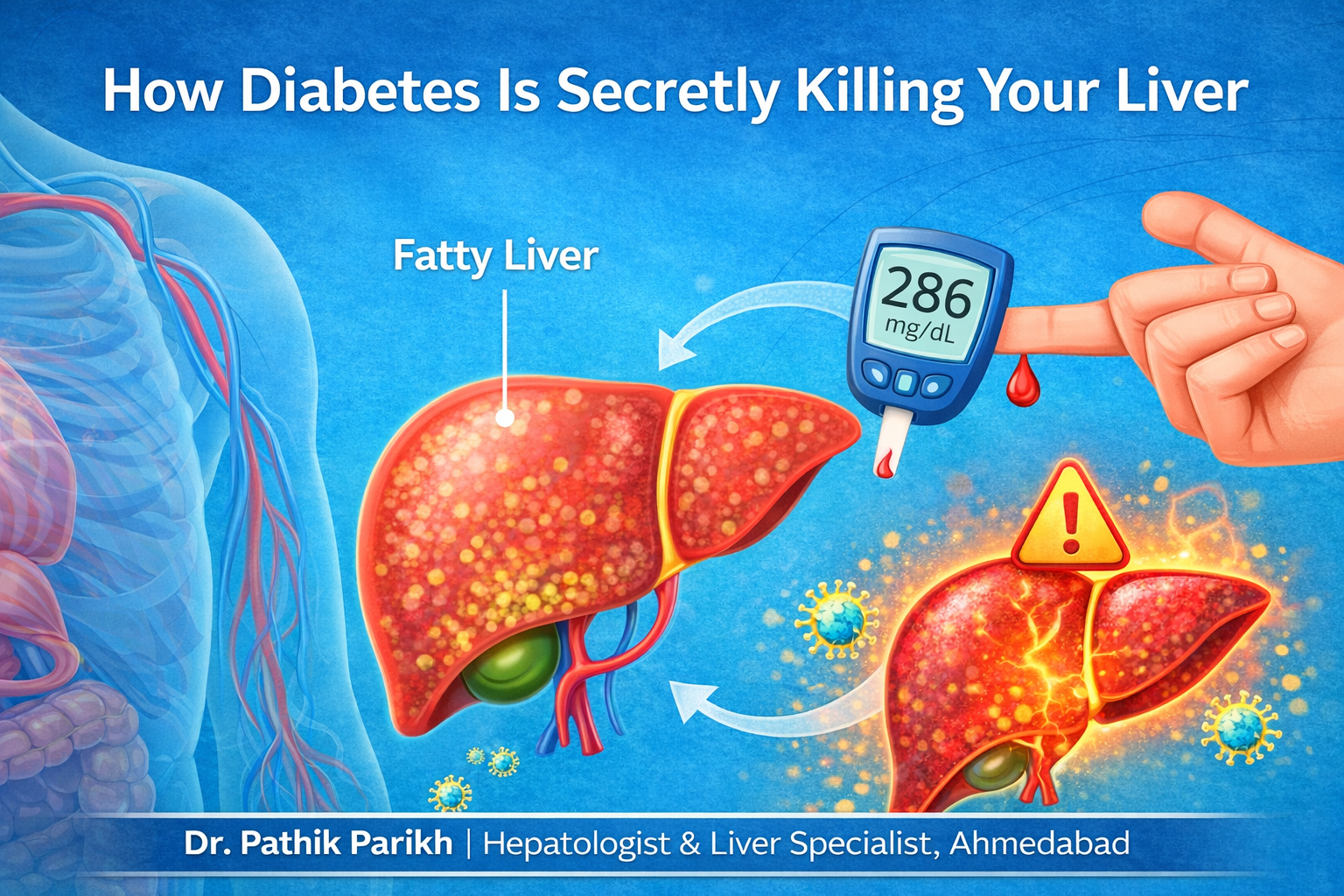
How Diabetes Is Secretly Killing Your Liver
A landmark study of over 5,600 patients has confirmed what doctors feared — for those with both diabetes and liver disease, the silent double threat is far deadlier than either condition alone.
By Dr. Pathik Parikh | Hepatologist & Liver Specialist, Ahmedabad
Most people know that diabetes is dangerous. High blood sugar, nerve damage, heart disease — the warnings are everywhere. But there is one organ quietly bearing the brunt of diabetes that rarely gets the attention it deserves: your liver. And a sweeping new study involving more than 5,600 patients has revealed just how deadly this hidden connection can be.
The research, published in Hepatology International in 2026 by Kumar, Arora, Maiwall and colleagues from the APASL ACLF Research Consortium — a network of hepatology centers across the Asia-Pacific region — examined patients suffering from a devastating condition called Acute-on-Chronic Liver Failure, or ACLF. Their findings are stark: patients with diabetes were nearly twice as likely to die within 90 days compared to those without the condition.
If you or someone you love has diabetes, this is not a story you can afford to skip.
What Is Acute-on-Chronic Liver Failure?
To understand why this matters, it helps to know what ACLF actually is. Imagine your liver — already weakened by years of damage from alcohol — suddenly being hit by a fresh, severe insult. The organ, which has been coping quietly for years, is now pushed past its breaking point. The result is ACLF: a rapid, catastrophic deterioration that leads to multi-organ failure and, in many cases, death.
ACLF is not a rare edge case. It is one of the most serious emergencies in modern hepatology and alcohol-related liver disease is its most common cause. The syndrome kills fast — often within weeks — and even with the best medical care, the odds of survival without a liver transplant are grim.
Mortality rate among diabetic patients with alcohol-related liver failure who did not receive a transplant — vs. 46% in non-diabetics (from the study’s matched cohort)
Into this already deadly picture, the new research introduces a critical and often overlooked variable: diabetes mellitus.
The Numbers Don’t Lie
The study drew from the AARC database — a massive, multinational registry of ACLF patients across Asia and beyond. Of 5,612 patients with documented outcomes, the researchers focused specifically on 2,096 with alcohol-related ACLF triggered by alcoholic hepatitis. Among these, 109 had diabetes and 1,987 did not.
To ensure a fair comparison — ruling out the possibility that diabetic patients were simply older or sicker to begin with — the researchers used a sophisticated statistical technique called propensity score matching, pairing each diabetic patient with two non-diabetic counterparts who had similar baseline characteristics.
What they found, even after this careful balancing, was alarming.
Key Findings at a Glance
Overall 90-day survival: 32% in diabetic patients vs. 57% in non-diabetics. Transplant-free survival: 31% in diabetics vs. 50% in non-diabetics. Diabetes independently increased the risk of death by 74% (Hazard Ratio 1.739), even after accounting for other factors like kidney function, bilirubin levels and disease severity. The primary causes of death: progressive liver failure, sepsis and multi-organ failure.
The log-rank p-value for both survival curves was less than 0.001 — statistical language for: this result is not a coincidence.
Why Diabetes Attacks the Liver from Multiple Angles
The critical question is: why? Why does diabetes make a liver crisis so much more lethal? The answer lies in a cascade of biological mechanisms that diabetes sets in motion — and that work synergistically to overwhelm the body’s ability to cope.
1. It Pours Fuel on the Fire of Inflammation
ACLF is fundamentally an inflammatory crisis. The liver — already damaged — triggers an immune firestorm that rapidly spreads to other organs. Diabetes makes this worse. Chronically elevated blood sugar promotes oxidative stress and drives up levels of pro-inflammatory signaling molecules including TNF-alpha and IL-6. These are the same inflammatory messengers that drive ACLF. In a diabetic patient, the inflammatory response is already primed and overactive. When ACLF hits, the result is an exaggerated immune reaction that accelerates organ failure.
2. It Weakens the Immune System’s Defenses
Here is the cruel paradox of diabetes and infection: the same condition that amplifies damaging inflammation also cripples targeted immune defenses. Diabetic patients have impaired neutrophil function — meaning the white blood cells that are supposed to hunt and destroy bacteria are less effective. This renders diabetic patients far more vulnerable to bacterial infections, which are both a trigger and an accelerator of ACLF. Sepsis — overwhelming systemic infection — was one of the leading causes of death in the study’s patient cohort.
3. It Poisons the Gut-Liver Axis
The gut and liver are intimately connected. Diabetes disrupts this relationship profoundly. Autonomic dysfunction — nerve damage caused by long-standing diabetes — slows the movement of food through the intestines, creating an environment where harmful bacteria flourish. This dysbiosis (imbalance of gut bacteria) leads to the translocation of bacterial products into the bloodstream, triggering systemic inflammation and increasing ammonia production. For a liver already struggling to filter toxins, this additional burden can be the difference between life and death.
4. It Accelerates Liver Scarring
Chronic high blood sugar drives the formation of advanced glycation end-products — AGEs — molecules formed when glucose binds to proteins and fats. AGEs are toxic to liver tissue. They activate hepatic stellate cells, the cells responsible for generating scar tissue (fibrosis) in the liver. More fibrosis means a liver with even less functional capacity to handle the crisis of ACLF.
5. It Sabotages Brain Function via the Liver
One of ACLF’s most feared complications is hepatic encephalopathy — a deterioration of brain function caused by the liver’s inability to clear ammonia and other neurotoxins from the blood. Diabetes makes this worse in two ways. First, insulin resistance disrupts muscle metabolism, increasing ammonia production. Second, the liver’s own capacity to clear ammonia is further compromised. The result: deeper, faster encephalopathy in diabetic patients.
The Silent Progression: How You Can Have Both — and Not Know It
Perhaps the most unsettling aspect of this story is how silently both conditions progress. Chronic liver disease, in its early and middle stages, produces few symptoms. The liver is remarkably tolerant — it can lose significant function before any warning signs appear. Similarly, type 2 diabetes can quietly damage the body for years, sometimes a decade, before diagnosis.
This means many people are unknowingly walking around with both a vulnerable liver and a diabetes-related biological profile that makes any liver crisis exponentially more dangerous. The AARC database showed that circulatory failure — a sign of severely compromised hemodynamic status — was far more common in diabetic ACLF patients even before matching (81% vs 60%), hinting that the combination of these two conditions may produce a more unstable physiological state from the very start.
The ‘ALD-Met’ Phenotype: A New Clinical Category
The researchers behind this study have recently proposed a new term — ‘ALD-Met’ — to describe patients who have both alcohol-related liver disease and concurrent metabolic risk factors such as diabetes, obesity, hypertension, or dyslipidemia. This combination, they argue, represents a distinct and particularly high-risk clinical subgroup that deserves dedicated research and specialized management protocols. If you or a patient fits this profile, the evidence now clearly indicates this is a category that demands heightened clinical vigilance.
What This Means for Patients and Families
The findings from this study carry direct, practical implications — not just for hepatologists, but for anyone living with diabetes, loving someone with liver disease, or working in primary care.
Get Screened for Liver Disease if You Have Diabetes
Non-alcoholic fatty liver disease (NAFLD/MASLD) affects a significant proportion of people with type 2 diabetes. Liver disease rarely announces itself early. A simple blood test measuring liver enzymes and, if indicated, a liver ultrasound or elastography scan can detect early damage. These are conversations worth having with your doctor.
If You Have Liver Disease, Control Your Blood Sugar Aggressively
The study’s authors are explicit on this point: the clinical implications of their findings support early identification of diabetes on hospital admission, frequent glucose monitoring and cautious use of insulin to maintain euglycemia while avoiding both hyperglycemia and hypoglycemia. This recommendation applies not just to ICU settings but to anyone with chronic liver disease managing blood glucose at home.
Understand That Standard Risk Scores May Underestimate Your Risk
Standard liver disease severity scores like MELD (Model for End-Stage Liver Disease) do not include diabetes as a variable. This study demonstrates that a diabetic patient with the same MELD score as a non-diabetic patient is meaningfully at higher risk. Clinicians and patients alike should factor diabetes status into prognostic conversations.
Sepsis Prevention Is Critical
In diabetic patients with liver disease, preventing infections is not merely about comfort — it may be lifesaving. Vaccinations, prompt treatment of infections, dental hygiene (oral bacteria can seed systemic infections) and careful wound management are all relevant. Discuss infection prevention strategies explicitly with your care team.
The Study’s Limitations — And Why Its Message Holds
Good science is transparent about its limitations and this study is no exception. The researchers acknowledge several constraints. The observational design means causality cannot be definitively proven. Granular glycemic data — HbA1c levels, glucose trends during admission — were not available, meaning we cannot yet say whether better blood sugar control during hospitalization would have improved outcomes. The population was predominantly male (over 90%) and confined to alcohol-related ACLF, so the findings may not apply identically to women or patients with different liver disease etiologies.
Perhaps most notably, the final matched study group of 327 patients represents only about 2% of the full registry — a consequence of strict eligibility criteria and data completeness requirements. The authors themselves urge caution in over-generalizing.
Yet none of these limitations undercut the study’s core message. If anything, they underscore the need for larger, prospective studies — ideally with detailed glycemic monitoring — to build on what is already a compelling and sobering finding.
The Bigger Picture: Diabetes as a ‘Systemic Amplifier’
What makes this research so conceptually important is the framing it provides. The authors describe diabetes as a systemic amplifier of organ injury in ACLF. This is not just a metaphor — it reflects a biological reality. Diabetes does not simply add risk on top of existing risk. It multiplies it. It turns what might be survivable liver failure into a multi-organ catastrophe through the simultaneous activation of inflammatory, infectious, metabolic and fibrotic pathways.
This framing helps explain why diabetes appeared as an independent predictor of mortality even after adjustment for established severity markers. It is not simply that diabetic patients are sicker — they are physiologically different in ways that current scoring systems don’t fully capture.
This same pattern has been observed in other severe illnesses. The same research group previously demonstrated diabetes’s adverse role in MASLD-related ACLF. Prior meta-analyses — including work on COVID-19 mortality — have shown similar amplification effects. Diabetes, it seems, makes almost every critical illness worse. But in the context of liver failure, where the margin between survival and death is already razor-thin, this amplification can be catastrophic.
What Needs to Happen Now
The authors of this study are clear about what they want to see. They call for structured inpatient diabetes management protocols for patients with liver disease. They advocate for early recognition of diabetes upon hospital admission as a standard triage consideration. They push for prospective studies to define optimal glycemic targets in the ACLF setting.
But beyond the clinical world, there is a message here for everyone. Diabetes and liver disease are two of the most common — and commonly underestimated — conditions in the modern world. They share risk factors, they share pathological mechanisms and, as this research demonstrates, they share a deadly synergy.
The liver is not the organ we think of first when we hear the word diabetes. That is precisely the problem. It should be.
If you have diabetes, ask your doctor about your liver. If you have liver disease, ask about your blood sugar. The conversation could save your life.