
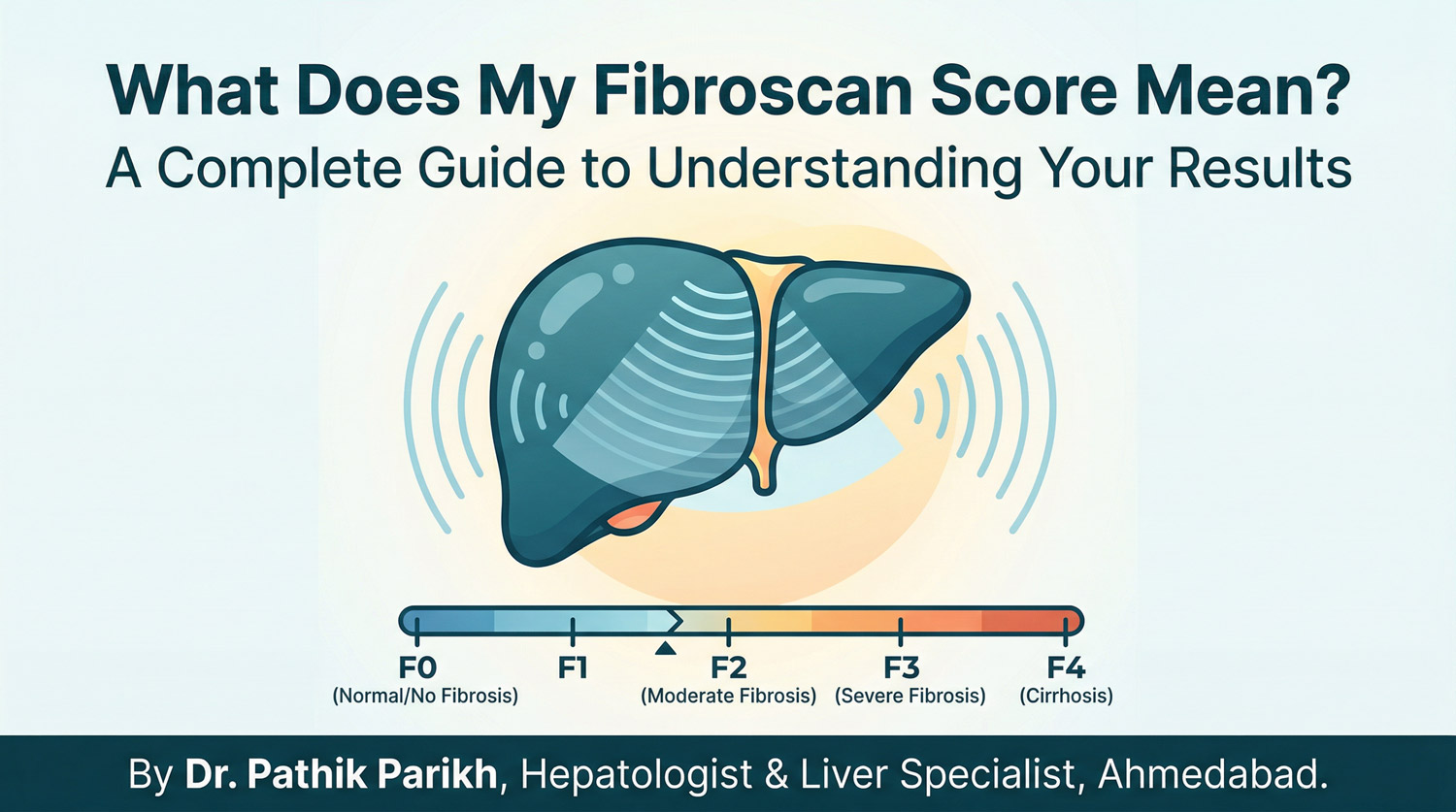
A Complete Guide to Understanding Your Results
By Dr. Pathik Parikh | Hepatologist & Liver Specialist, Ahmedabad
You’ve just had a Fibroscan done, and you’re staring at a report with numbers like ‘8.2 kPa’ or ‘274 dB/m’ — and you have no idea what they mean. You’re not alone. This is one of the most common questions patients ask in clinic.
This guide explains exactly what a Fibroscan measures, how to read your score, and most importantly — what you should do next.
What Is a Fibroscan?
A Fibroscan (also called Transient Elastography) is a painless, non-invasive test that measures the health of your liver in about 10 minutes. No needles, no anaesthesia, no recovery time — you simply lie down and a probe is placed on your skin near the liver.
It measures two things:
- Liver Stiffness (fibrosis/scarring) — reported in kilopascals (kPa)
- Liver Fat (steatosis) — reported as a CAP score in decibels per metre (dB/m)
Think of it this way: the stiffer the liver, the more scarring there is. The higher the CAP score, the more fat is present.
Why Is Fibroscan Better Than a Biopsy or Ultrasound?
For most patients, Fibroscan has largely replaced the need for a liver biopsy to assess fibrosis. Here’s why it’s preferred:
| Feature | Fibroscan | Liver Biopsy |
| Pain / Discomfort | None | Moderate |
| Needles / Invasive | No | Yes |
| Time Required | ~10 minutes | Hours (with recovery) |
| Risk | None | Small risk of bleeding |
| Liver Fat Measurement | Yes (CAP score) | No |
| Cost | Affordable | Expensive |
| Repeatability | Can repeat regularly | Not recommended frequently |
A standard liver ultrasound can detect fat but cannot accurately measure the degree of fibrosis. Fibroscan does both.
Part 1: Understanding Your Liver Stiffness Score (kPa)
The kPa (kilopascal) score tells your doctor how much scarring or fibrosis is present in your liver. Fibrosis is staged from F0 (no scarring) to F4 (cirrhosis).
| Fibroscan Score (kPa) | Fibrosis Stage | What It Means | What To Do |
| Less than 7.0 kPa | F0 – F1 | Normal to minimal fibrosis | Maintain healthy lifestyle. Annual monitoring if risk factors present. |
| 7.0 – 9.5 kPa | F2 | Mild to moderate fibrosis | Lifestyle changes needed. See a hepatologist for a plan. |
| 9.5 – 12.5 kPa | F3 | Significant fibrosis (pre-cirrhosis) | Medical evaluation essential. Treatment and close monitoring required. |
| Above 12.5 kPa | F4 | Cirrhosis (advanced scarring) | Urgent specialist care required. Comprehensive management plan needed. |
Important Note About kPa Scores
- Fibroscan scores can be falsely elevated if the test is done soon after eating, if the patient is obese (BMI > 30), or if there is active liver inflammation (high ALT levels).
- Always interpret your kPa score in context with your blood tests and clinical history.
- A single Fibroscan result should never be used alone to make major treatment decisions — your doctor will consider the full picture.
Part 2: Understanding Your CAP Score (Liver Fat)
The CAP score (Controlled Attenuation Parameter) measures the amount of fat in your liver cells. It is reported in dB/m (decibels per metre) and graded from S0 to S3.
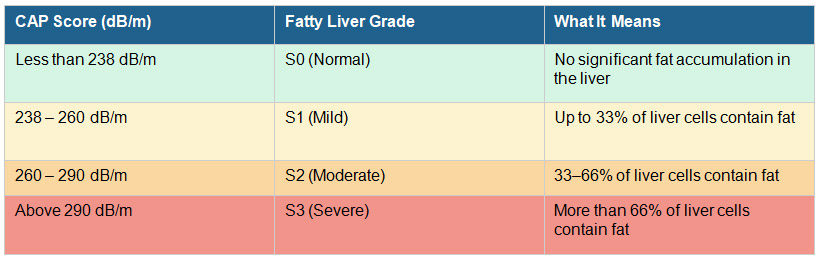
If your CAP score is S2 or S3, you likely have Non-Alcoholic Fatty Liver Disease (NAFLD). The good news: with dietary changes and regular exercise, fatty liver is reversible — especially at grades S1 and S2.
Reading a Real Fibroscan Report: Examples
Example 1: The Routine Check-Up
Report: kPa = 5.8 | CAP = 220 dB/m
|
Example 2: The Diabetic Patient
Report: kPa = 8.8 | CAP = 285 dB/m
|
Example 3: The High-Risk Patient
Report: kPa = 14.2 | CAP = 310 dB/m
|
Who Should Get a Fibroscan?
A Fibroscan is recommended for anyone who:
- Has been diagnosed with fatty liver on an ultrasound
- Has elevated liver enzymes (SGPT/SGOT/ALT/AST) on blood tests
- Has Type 2 diabetes, obesity, or metabolic syndrome
- Has Hepatitis B or Hepatitis C infection
- Consumes alcohol regularly
- Has a family history of liver disease or cirrhosis
- Is overweight or has a BMI above 25
- Has been on long-term medications that can affect the liver
If you fall into any of these categories and have never had a Fibroscan, speak to a hepatologist about getting one done.
How to Prepare for a Fibroscan
To ensure accurate results, follow these simple instructions:
- Fast for at least 2 hours before the test (eating raises liver stiffness temporarily)
- Avoid alcohol for at least 24 hours before the test
- Wear loose, comfortable clothing that allows easy access to the right side of your abdomen
- Inform your doctor if you have a pacemaker or any implanted electronic devices
- The test takes approximately 10 minutes and is completely painless
What Happens After Your Fibroscan?
Depending on your results, your hepatologist will recommend one of the following:
If Your Score Is F0–F1 (Normal)
- No treatment needed
- Maintain a healthy diet and active lifestyle
- Repeat Fibroscan every 2–3 years if you have ongoing risk factors like diabetes or obesity
If Your Score Is F2 (Mild–Moderate Fibrosis)
- Dietary and lifestyle changes are essential
- Blood tests to identify the underlying cause (diabetes, cholesterol, thyroid, etc.)
- Follow-up Fibroscan in 6–12 months to track progress
- Possible medication if lifestyle changes alone are insufficient
If Your Score Is F3–F4 (Advanced Fibrosis / Cirrhosis)
- Urgent comprehensive liver evaluation required
- Endoscopy to check for varices (enlarged veins in the oesophagus)
- Regular blood tests: liver function, AFP (liver cancer marker), INR
- 6-monthly ultrasound to screen for liver cancer (hepatocellular carcinoma)
- Specialist management plan — this stage requires close, ongoing care
FAQ’s
- Is a Fibroscan the same as an ultrasound?
No. An ultrasound shows the structure and size of the liver and can detect fat, but cannot measure the degree of fibrosis. A Fibroscan specifically measures liver stiffness (fibrosis) and fat content with much greater accuracy. - Can a Fibroscan detect liver cancer?
No. Fibroscan measures fibrosis and fat — it does not screen for liver cancer. If you have F3–F4 fibrosis, your doctor will additionally arrange a 6-monthly liver ultrasound and AFP blood test to screen for cancer. - My kPa was high but my doctor says my blood tests are fine. Which is correct?
Both can be true at the same time. Blood tests (liver enzymes) can appear normal even when fibrosis is present. Fibroscan picks up structural changes that blood tests can miss — this is exactly why it is so valuable. - Can fibrosis be reversed? Yes — at stages F1 and F2, fibrosis is largely reversible with lifestyle changes, treatment of the underlying cause, and close medical monitoring. At F3 and F4, progression can be halted but reversal is less predictable.
- How often should I repeat a Fibroscan?
If your liver is healthy (F0–F1), every 2–3 years is sufficient. If you have F2 or above, your hepatologist will advise a repeat every 6–12 months depending on your condition. - Is Fibroscan available in Ahmedabad?
Yes. Fibroscan is available at Dr. Pathik Parikh’s clinic in Ahmedabad. It is a quick, walk-in procedure with results available immediately.
Had a Fibroscan? Let’s Discuss Your Results.
A number on a report is just the starting point. Dr. Pathik Parikh will explain what your Fibroscan result means for your specific situation and guide you on the right next steps — whether that’s lifestyle management, medication, or closer monitoring.
Dr. Pathik Parikh — Hepatologist & Liver Specialist, Ahmedabad
📞 Book an Appointment: Click Here
Medical Disclaimer: This article is for educational purposes only and does not substitute professional medical advice. Score ranges provided are general guidelines — actual interpretation depends on your full clinical history. Please consult Dr. Pathik Parikh or a qualified hepatologist to discuss your specific Fibroscan results.